Bench it once. Sell against it all year.
ProductBench is a guided workspace for hands-on competitive teardowns. Follow a Bench Protocol, capture the evidence, and turn it into battle cards, briefs, and comparisons whenever a deal needs one.
Want a head start? We'll run your first teardown with you.
Software intel tools can't hold a screwdriver.
Klue and Crayon scrape websites. That works for SaaS. It doesn't tell your team that the competitor's mic clips at four metres, that the mount flexes under its own cable, or that setup takes nine taps instead of three. In hardware, deals are won on the things you only learn with the device on the bench. Today that knowledge lives in one person's head, a slide from 2024, and a Drive folder nobody opens.
A hardware team runs a handful of teardowns a year. The findings get used in deals almost every week.
Most competitive knowledge leaves when the person who did the teardown does.
Reps get 90 seconds before a call. A 30-page teardown isn't the format.
Evidence your team can point at.
Every photo, clip, measurement, and note attaches to a specific criterion, so when a rep says "their auto-framing hunts in low light," there's a 42-second clip behind the claim.
Bench Protocols make anyone a reliable tester.
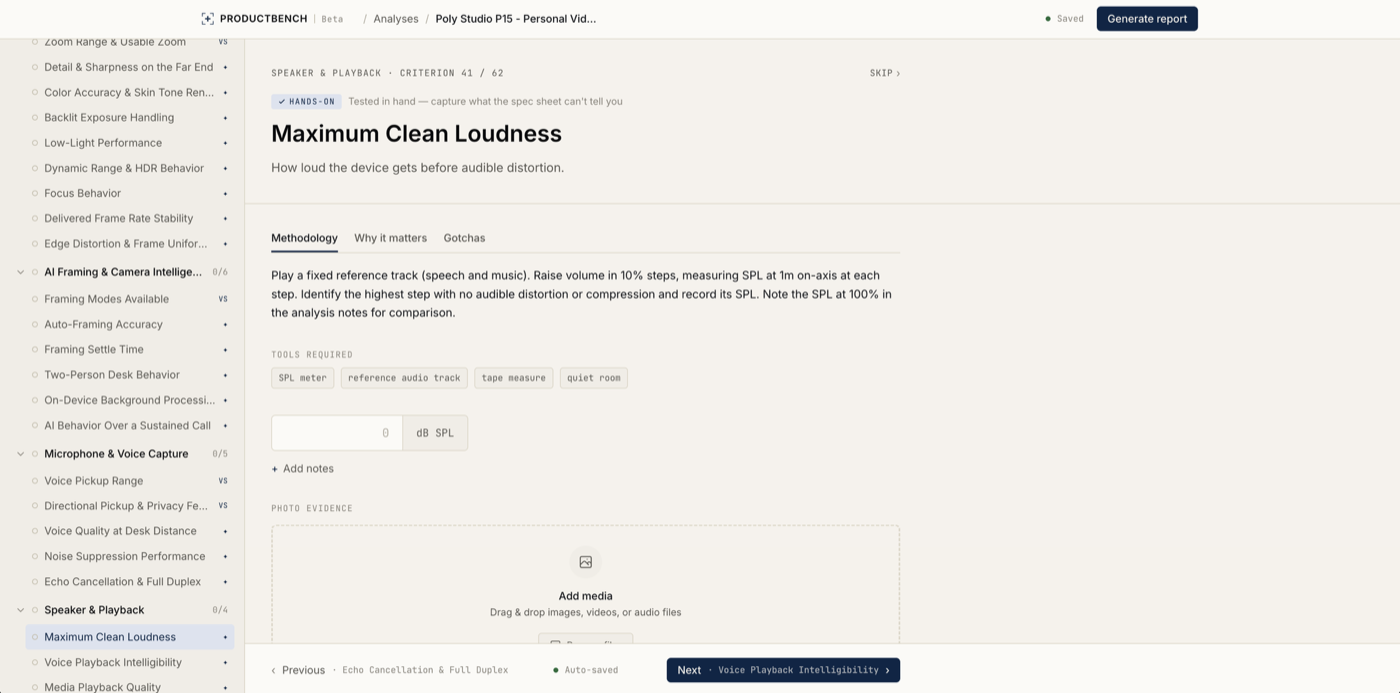
Bench Protocols for 12 hardware categories walk anyone through the same tests, measured the same way, so every teardown holds up in a deal. 438 criteria, each with instructions for exactly how to test it.
- Place the device at table height, centered on the wall.
- Read the test passage at conversational volume from 2 m, 4 m, and 6 m.
- Record the far end at each distance.
- Log the furthest distance with clear, undistorted pickup.
Captured a few times a year. Used in every deal.
Once a competitor is in your library, anyone on the team can generate what they need, when they need it. Same evidence, every audience.
Before a competitive demo
Generate a battle card tuned to the buyer's rooms and priorities.
Lead with audio: our measured pickup is 7.5 m vs their 5.5 m.
MeasuredWhen a buyer asks for a side-by-side
Produce a customer-facing comparison your prospect can forward internally.
When a competitor launches
A competitor launches Tuesday. Your reps have a battle card by Friday. Measured findings replace claimed specs once it's on the bench.
"Beautiful hardware that lies about its lens and struggles past row two."
The Meridian M2 is a fictional conference bar we built so we could publish a complete teardown publicly, at full depth, with nothing sanitized. The format and capture method are exactly what a real engagement produces.
Your first teardown, done with you.
You don't have to learn the protocol alone. We run your first teardown alongside your team, then you run the next ones yourself.
-
01
Walkthrough call.
Tell us the competitor that keeps showing up in your deals.
-
02
We bench it together.
Over two weeks we run the Bench Protocol with your team and build out your workspace.
-
03
Your team takes it from there.
Add new competitors, run teardowns, and generate outputs whenever you need them.
Start with a pilot: $1,500 flat.
One competitor device, benched with your team over two weeks. Includes the full teardown, every output format, and workspace access. Invoice-based, so procurement is one email.
Ongoing plans are shaped with early customers.
Why ProductBench exists
The truth about hardware is physical. Spec sheets are marketing documents, and the things that actually decide deals, how a device installs, how it behaves in a real room, whether the claims survive measurement, only show up with the product on a bench in front of you. Competitive intelligence went software-only and left that truth behind.
ProductBench brings it back. Every teardown starts with the actual device, and every claim traces to something observed, not something read.
Bench Protocols turn that practice into something any team can run, and run the same way twice.
Common questions.
Who can run a teardown?
Anyone who can follow a checklist and use a phone camera. Each Bench Protocol spells out what to test and exactly how to measure it, so results stay consistent no matter who runs them.
What happens when a competitor launches something new?
Add it to your library. Spec capture gets it in right away, and hands-on findings replace the claims once the device is on your bench.
Why is the sample product fictional?
Real client teardowns are confidential. The Meridian M2 lets us publish a complete report at full depth with nothing redacted, so you can judge exactly what you'd receive.
Who owns the analysis?
You do. Reports, exports, and workspace data are yours.
Can we add criteria that matter to our deals?
Yes. Bench Protocols can be extended for your team.
Do you work with our competitors?
For pilot teardowns, one side per rivalry. We don't run engagements for direct competitors of an active client.
See it on the competitor you keep running into.
Book a 20-minute walkthrough. Bring the device that keeps showing up in your deals.